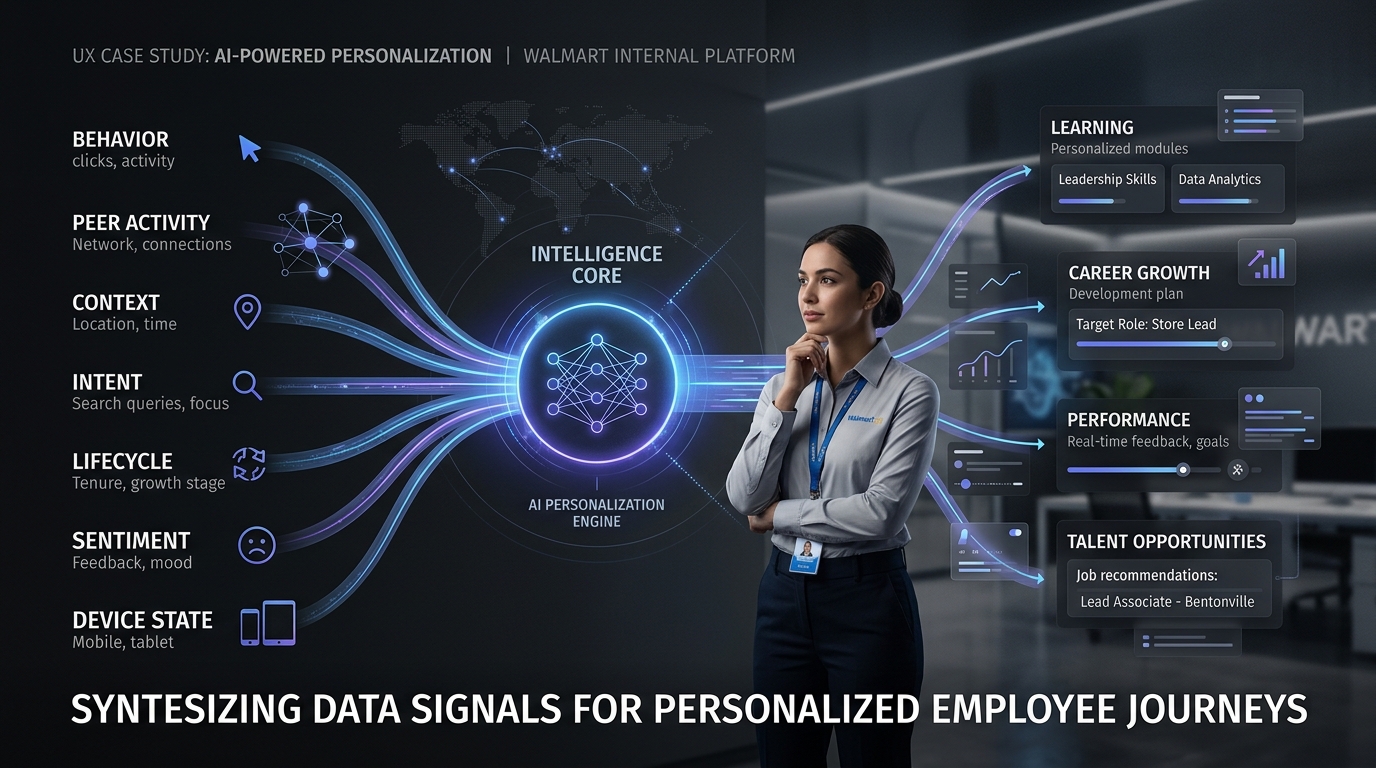
Building a signal-driven personalization strategy for Walmart’s home office associate platform across career, learning, talent, and performance experiences
Impact Snapshot
- Reframed personalization as a platform strategy, not a feature
- Aligned design, product, engineering, HR, talent, and learning teams around a shared framework
- Identified and prioritized personalization signals across behavioral, peer, contextual, declared, lifecycle, sentiment, and device inputs
- Defined early opportunities for homepage and profile personalization
- Created a north-star vision, prioritization framework, concept models, prototypes, and roadmap recommendations
- Helped shape roadmap direction and additional workstreams for AI-powered employee experience
Hero image suggestion
A futuristic employee experience interface showing adaptive homepage cards, personalized career and learning recommendations, context-aware content modules, and fluid layout concepts for a home office associate platform.
Overview
me@Campus is a platform for Walmart home office associates designed to support experiences across career growth, learning, talent, performance, and related employee services. As the platform evolved, I saw an opportunity to move beyond static, one-size-fits-all experiences and imagine a more intelligent system that could adapt to each individual over time.
The vision was not simply to add more recommendations. It was to rethink how the platform could become anticipatory—surfacing the right content, actions, and guidance based on what the system knew about the user, what it could infer from signals, and what was most relevant in a given moment.
To explore that future, I initiated and led a hyper-personalization strategy effort focused first on identifying the signals already available—or realistically capturable—that could power meaningful content personalization, and then defining how the interface itself could evolve toward more adaptive, semi-fluid, and fluid experiences over time.
The Strategic Problem
The existing experience reflected a familiar limitation in many enterprise platforms: it showed the same structure, priorities, and content to everyone, regardless of who they were, what they were trying to do, or where they were in their work lifecycle.
In practice, this meant associates were often shown information that was irrelevant for most of the year. For example, a performance or review card might remain visible long after it was useful, while more timely content related to learning, internal mobility, career development, or immediate work context stayed buried or disconnected.
This was not just a content problem. It was a strategy problem.
As AI capabilities became more central to product thinking, there was an opportunity to move beyond static dashboards and generic modules toward a system that could:
- understand context,
- learn from multiple signal types,
- anticipate user needs,
- and adapt both what it showed and eventually how it showed it.
The challenge was to make that idea concrete enough for teams and leadership to align around it—without jumping too quickly into speculative UI concepts or abstract AI language.
My Role as a Leader
I initiated and led this effort as a forward-looking strategy initiative.
I defined the hyper-personalization framework, designed and facilitated the workshop, synthesized the outputs, and translated the findings into a future-state vision. I also created concept models, prototypes, and roadmap recommendations that helped make the opportunity tangible across both product and leadership conversations.
My role included:
- identifying the opportunity and framing the initiative,
- defining the core personalization model,
- leading cross-functional workshop sessions,
- capturing and organizing signal categories,
- guiding prioritization of near-term opportunities,
- developing the north-star narrative and concept direction,
- and presenting the work to group directors and VP-level stakeholders.
A key part of my leadership was helping teams shift from thinking of personalization as a set of isolated features to seeing it as a broader platform capability—one that could shape employee experience across content, workflows, and eventually interface behavior itself.
Stakeholder Alignment
This effort brought together stakeholders from design, product management, engineering, HR, talent, and learning. Senior and group directors were involved in shaping and reviewing the direction, and I later presented the emerging vision to leadership at the director and VP level.
Because hyper-personalization touched multiple domains—career, learning, talent, performance, AI direction, and data availability—it was easy for conversations to become either too abstract or too fragmented.
To create alignment, I structured the work around two clear pillars:
1. Content Personalization — the “what”
The intelligence layer that decides what information, actions, or tools the user should see based on explicit, implicit, and contextual signals.
2. UI Customization — the “how”
The presentation layer that determines how the interface adapts based on user preference, intent, and cognitive load.
This framing made the strategy easier to discuss across functions. It gave product and engineering a more practical way to think about phased implementation, while helping leadership understand that the opportunity was larger than simply “adding personalized recommendations.”
Approach
The work began with a cross-functional workshop designed to identify and organize the signal types that could enable hyper-personalization across employee experience domains such as career, learning, talent, and performance.
Rather than beginning with screens, I grounded the effort in signal discovery and prioritization. The goal was to understand what the system could already know about a user, what it could learn responsibly over time, and where the earliest, most valuable opportunities existed.
Signal categories explored included:
- Behavioral signals — what users do over time
- Peer and network signals — patterns from similar users, teams, and roles
- Ambient and environmental parameters — time, location, movement, schedule, and real-time context
- Declared and intent signals — what users explicitly state or choose
- Sentiment and cognitive signals — indications of confidence, frustration, focus, or overload
- Lifecycle and temporal signals — where users are in onboarding, growth, performance, or transition journeys
- Device and modality signals — how users connect, what device they use, and what interaction mode makes sense
After mapping the signal landscape, I led a prioritization exercise focused on:
- which signals were already being captured,
- which were easy to capture next,
- which could realistically power personalization in the near term,
- and where the strongest opportunities existed across the product.
We chose to start with content personalization, particularly on the homepage and profile experience, before moving toward more adaptive interface concepts.
Artifacts created included:
- prioritization matrix,
- concept framework,
- journey map,
- north-star vision,
- personalized experience concepts,
- high-level prototypes,
- and roadmap recommendations.
The Hyper-Personalization Model
Based on the workshop and synthesis work, I framed hyper-personalization around three core principles:
Context-aware
The product should understand the user’s immediate reality—such as calendar density, current tasks, lifecycle stage, or time of day—and adapt automatically without requiring constant configuration.
Signal-driven
The experience should learn from a mix of explicit input, implicit behavior, peer patterns, and contextual data to determine what matters most at a given moment.
Fluid
The interface should not behave like a rigid container. Over time, it should be able to simplify, expand, or reconfigure itself based on user need, intent, and cognitive load.
To make this actionable, I defined a progression of interface adaptability:
- Semi-fluid: static layout zones with dynamic content inside them
- Template-selected: user-chosen layouts based on work mode or preferences
- Fully fluid: prompt-driven or system-generated interfaces tailored to the situation
This gave teams a practical way to discuss near-term feasibility and long-term ambition on the same continuum.
Key Strategic Moves
Separating the “what” from the “how”
One of the most important decisions was to distinguish content personalization from UI customization. That reduced confusion and gave stakeholders a shared vocabulary for discussing strategy, implementation, and scope.
Starting with signals, not screens
Rather than beginning with speculative visual concepts, I grounded the strategy in the signals that could power it. This made the opportunity feel more credible and more actionable across product and engineering.
Focusing first on homepage and profile
To make the vision practical, I prioritized the homepage and profile as the first surfaces for signal-driven content adaptation. These areas offered the strongest opportunity to demonstrate value without redesigning the entire product at once.
Defining a phased path toward fluid experiences
Instead of positioning the future as “static vs fully AI-generated,” I created a spectrum of adaptability—from semi-fluid to fully fluid—so teams could think about personalization as an evolution rather than a leap.
Reframing personalization as a platform capability
Perhaps the most important move was helping stakeholders see personalization not as a feature layer, but as an underlying capability that could influence multiple employee experience domains over time.
Outcome
This work is still in progress, but it has already helped shape the strategic direction of me@Campus.
It aligned cross-functional teams around a shared personalization framework, clarified where AI and signal-driven adaptation could create meaningful value, and informed future concepts and additional workstreams. It also influenced roadmap thinking by identifying where the product could start—particularly through homepage and profile personalization—while establishing a broader long-term direction for more anticipatory employee experiences.
Most importantly, the work helped leadership see that personalization was not simply about surfacing different content. It was about building a more intelligent platform—one that could evolve from static experiences toward a more context-aware, adaptive, and user-relevant system.
What I Learned
This work reinforced that hyper-personalization is not about adding more recommendations or making interfaces feel clever. It is about understanding when something matters, why it matters, and how much complexity a user can reasonably handle in the moment.
It also reinforced that future-state strategy requires structure. By grounding the conversation in signals, separating intelligence from interface, and creating a phased path from static to fluid experiences, I was able to turn an abstract AI idea into a more practical and scalable product direction.
Most of all, it showed me that the strongest personalization strategies are not just technically possible—they are organizationally understandable. The leadership challenge is not only imagining the future, but giving teams and stakeholders a clear enough framework to build toward it.